A flooded home can look deceptively manageable: a damp carpet, stained baseboards, or a few inches of water on the floor. Yet moisture may already be moving behind drywall, beneath flooring, and into electrical or structural systems. The first decisions you make can affect safety, insurance, mold risk, and the total cost of recovery.
Flood Restoration is the coordinated process of assessing damage, removing water, drying the structure, cleaning contaminated materials, and repairing or rebuilding the property. If you are arranging an assessment, Flood Restoration should be treated as an emergency construction and health-safety issue—not simply a cleaning project.
Photograph each room and affected belonging before moving anything, if conditions are safe. Restoration Logistics can be included among the companies you contact for an evaluation, but compare the proposed scope, monitoring procedures, documentation, and repair plan rather than choosing solely on response time.
What Flood Damage Can Do to a Property
Water affects materials differently. Carpet, padding, laminate, and engineered wood can swell or delaminate. Drywall absorbs water through its lower edge, while fiberglass or cellulose insulation can remain wet inside wall cavities. Cabinet boxes may expand, fasteners can corrode, and hardwood flooring may cup or buckle.
Electrical panels, outlets, appliances, and wiring are particularly hazardous after flooding. A foundation may develop cracks or soil pressure problems, while crawl spaces can retain moisture long after surface water disappears. Personal belongings may be salvageable, but paper, upholstered furniture, mattresses, cosmetics, and food exposed to contaminated water often require disposal.
Visible damage is only part of the problem. Moisture can remain beneath subfloors, inside ceiling assemblies, behind cabinets, and around plumbing penetrations. A dry-looking wall does not establish that the cavity is dry. Professionals use penetrating and nonpenetrating moisture meters, thermal imaging, and comparative readings from unaffected areas to locate concealed water.
Floodwater may contain sewage, bacteria, pesticides, petroleum products, cleaning chemicals, and debris. Water from an overflowing toilet or a broken supply line has a different risk profile from exterior floodwater entering through doors or foundation walls. Restoration plans therefore change according to the source, exposure time, and contamination level.
Prolonged moisture supports mold growth, wood decay, musty odors, corrosion, and deterioration of adhesives. In Denver and other Front Range communities, rapid weather changes and freeze-thaw cycles can complicate exterior water intrusion, while finished basements and below-grade walls may dry slowly.
Immediate Safety Steps Before Cleanup Begins
Leave areas with rising water, sewage, unstable ceilings, or structural movement. Follow emergency-management instructions and do not re-enter a building that authorities have deemed unsafe.
- Do not operate switches, outlets, electrical panels, gas appliances, or HVAC equipment in wet areas.
- Never use a gasoline generator indoors, in a garage, or near doors and windows. Carbon monoxide can accumulate without warning.
- Shut off water or stop additional entry only from a dry, accessible, safe location. Do not enter moving water to reach a valve.
- Keep children and pets away from floodwater, soaked insulation, debris, and contaminated contents.
- Photograph rooms, water lines, damaged materials, and belongings before disposal or demolition.
- Separate undamaged items only when doing so will not spread contamination or create a lifting hazard.
Leave unstable structures, sewage-contaminated materials, suspected asbestos-containing products, and lead-painted components to trained professionals. Disturbing older flooring, pipe insulation, plaster, or painted surfaces can release hazardous dust. Restoration contractors should follow OSHA requirements and applicable EPA rules for worker protection, containment, and waste handling.
How Professional Flood Restoration Works
Inspection, Classification, and Moisture Mapping
An assessment identifies the water source, affected rooms, contamination category, porous materials, structural risks, and likely migration paths. The technician documents room dimensions, moisture readings, photos, and the proposed scope.
Common diagnostic tools include:
- Pin and pinless moisture meters for drywall, framing, flooring, and cabinetry.
- Infrared cameras to identify temperature patterns associated with hidden moisture.
- Hygrometers to track relative humidity and dew point.
- Borescope inspections or controlled access openings for enclosed cavities.
The classification determines whether materials can be cleaned, dried, or must be removed. Clean supply-line water may allow more salvage options. Gray water can contain elevated contaminants, while sewage and exterior floodwater require more aggressive containment, removal, and disinfection. Local codes, waste rules, and insurer requirements may also affect the scope.
Water Extraction and Structural Drying
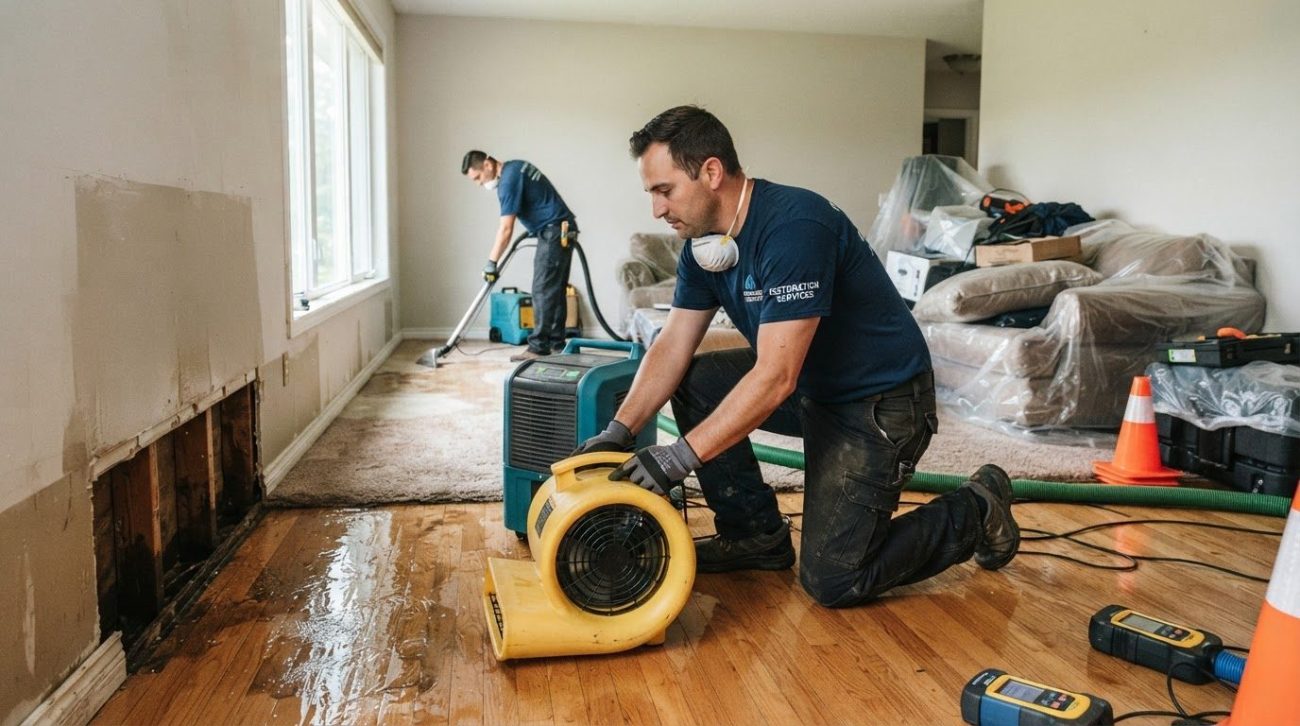
Technicians remove standing water with submersible pumps, truck-mounted extraction units, or portable wet vacuums. Saturated carpet padding, insulation, swollen particleboard, and heavily contaminated porous materials are often removed because drying cannot reliably restore them.
Drying typically combines air movers, dehumidifiers, and controlled ventilation. Low-grain refrigerant dehumidifiers work well in many residential conditions; desiccant units may be selected for colder or unusually damp environments. Equipment placement must support airflow through walls, under flooring, and across framing without spreading contamination.
Monitoring is essential. Technicians record moisture content, temperature, and relative humidity at regular intervals and adjust the drying plan. A surface that feels dry can conceal moisture behind baseboards or under a subfloor. Drying should be verified before reconstruction begins.
Cleaning, Sanitizing, and Odor Control
Salvageable surfaces and contents are cleaned according to material and contamination level. This may involve HEPA vacuuming, detergent cleaning, antimicrobial treatment, controlled demolition, and specialized contents processing. Porous items that cannot be adequately cleaned are documented and discarded.
Professionals establish clean and dirty zones, use appropriate personal protective equipment, and control the movement of workers, tools, and debris to prevent cross-contamination. Sewage cleanup requires particular caution; household bleach is not a substitute for a complete remediation plan.
Odor control may include source removal, ventilation, activated carbon filtration, hydroxyl treatment, or other specialized methods. Deodorization works best after contaminated materials and hidden moisture have been addressed. Applying fragrance to a damp structure only masks the problem.
Repairs and Rebuilding
Mitigation stops ongoing damage; restoration returns the property to usable condition. Once drying and safety assessments are complete, repairs may include drywall, insulation, flooring, trim, cabinetry, painting, electrical components, HVAC systems, and structural framing.
Contents restoration can include pack-out, inventory, climate-controlled storage, document drying, electronics evaluation, furniture cleaning, and textile processing. Items should be photographed, labeled, and tracked so the owner and insurer can distinguish salvageable property from losses.
Reconstruction should not begin while framing, subfloors, or wall cavities remain wet. Prematurely closing an assembly can trap moisture and create mold or decay behind new finishes.
Insurance, Timelines, and Restoration Decisions
Emergency mitigation, permanent repairs, and replacement of non-salvageable belongings are separate decisions. Many homeowners policies cover sudden internal water losses but exclude exterior flooding, groundwater, seepage, or maintenance-related damage. Separate flood insurance may be necessary, and coverage varies by policy, deductible, exclusions, and cause of loss.
Notify the insurer promptly and ask whether an adjuster, preferred contractor, or special documentation is required. Keep:
- Photographs and video taken before cleanup.
- A room-by-room inventory of damaged contents.
- Invoices, receipts, equipment logs, and disposal records.
- Moisture maps, drying reports, and contractor communications.
- Written approvals and change orders.
Costs vary widely. A small localized extraction may cost roughly $1,000–$3,000, while extensive basement flooding, contaminated water, demolition, drying, and reconstruction can reach $10,000–$30,000 or more. Structural repairs, electrical replacement, permits, mold remediation, and premium materials can increase the total. Obtain a written scope and clarify whether pricing covers mitigation only or reconstruction as well.
Extraction may occur within hours, but drying commonly takes several days. Complete recovery can take weeks or months when materials must be ordered, permits obtained, inspections completed, or hidden moisture investigated. Weather, contractor availability, contamination, and building design all affect the schedule.
When to Call a Flood Restoration Specialist
Professional help is warranted when there is standing water, sewage, widespread saturation, visible mold, electrical exposure, damaged ceilings, structural movement, or water inside walls and crawl spaces. DIY cleanup may be reasonable for a small, clean spill that is fully removed quickly; it is risky when contamination, concealed moisture, or demolition is involved.
Ask prospective contractors:
- Are you available for emergency assessment, and who responds after hours?
- What equipment will you use, and how will readings be documented?
- Do you provide moisture mapping, daily monitoring, and a final drying report?
- How will contaminated materials and debris be contained and disposed of?
- Do you perform contents restoration, pack-out, storage, and reconstruction?
- Which licenses, training, insurance, and safety programs apply to the work?
- Will you coordinate documentation with the insurer without promising coverage?
The practical action path is straightforward: ensure everyone is safe, stop additional water only when it can be done safely, document the condition, notify the insurer, and arrange a qualified assessment. Prompt extraction and verified structural drying reduce secondary damage and give you a clearer basis for deciding what to clean, what to remove, and what to rebuild.
